

Share this
by Collin Chlebak on March 12 2026
Most multifamily portfolios simply absorb insurance market swings. Premiums rise, deductibles increase, and owners frustratingly adjust their budgets and NOI accordingly.
Incorporating a Plus Aggregate in your property insurance structure helps smooth out that volatility. This technique helps marry the goals of the portfolio owner (predictable insurance costs) with those of the carriers (a partner with skin in the game). The goal is to create predictable insurance costs over the next five years, regardless of where the market moves.
To illustrate how this works, imagine a hypothetical 7,000-unit, $950M TIV multifamily portfolio spanning the Midwest and the Sun Belt. In the example below, we compare a traditional deductible insurance program with a $1M Plus Aggregate structure over a six-year period.
The Plus Aggregate structure allows the insured to participate (in a limited capacity) in the profitability of the insurance program. The insured participates by funding the Plus Aggregate by charging premium and is wins or losses based on the profitability of that layer of insurance. If the insured doesn’t have losses, they’re rewarded and keep $1M. If they have losses, the first $1M of losses is paid out of the Plus Aggregate Fund, but capped at the selected Plus Aggregate amount, which is again $1M in this scenario. When losses are moderate, a Plus Aggregate structure can allow owners to retain part of the margin typically built into traditional premiums while maintaining protection against larger events.
Annual Cost Comparison
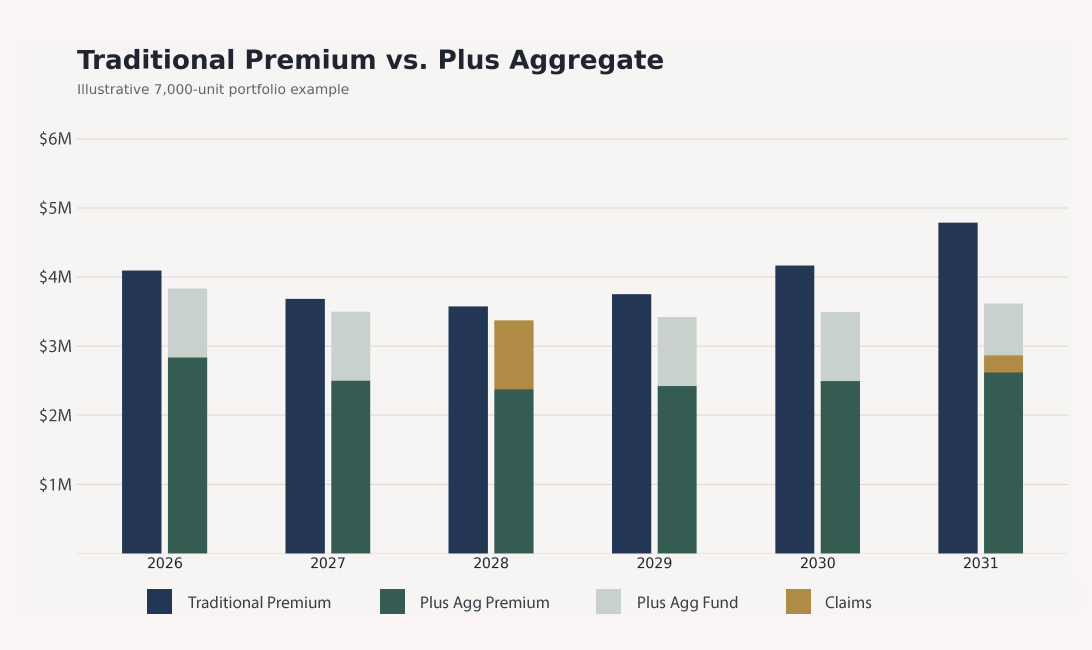
The chart above compares the traditional premium each year to the Plus Aggregate structure, which includes hard premium, claims incurred, and the remaining allocated layer.
Cumulative Cost Savings
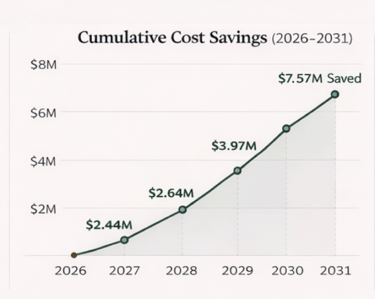
Over time, the difference between the two approaches compounds. In this illustrative scenario, the portfolio saves $7.57M over six years.

In this example:
-
Traditional insurance total (6-year) spend: $24,065,774
-
Plus Aggregate total (6-year) spend: $16,492,280
-
Total Claims paid (6-years) from the allocated layer: $1,249,995
-
Total savings over 6-years: $7,573,494